
- 18 U.S.C. § 1466A: Obscene Visual Representations of the Sexual Abuse of Children
- 18 U.S.C. § 2251(a): Production of Child Pornography / Sexual Exploitation of Children
- 18 U.S.C. § 2251(d)(1): Advertisement
- 18 U.S.C. § 2252A(a)(1) and § 2252(a)(1): Transportation of Child Pornography
- 18 U.S.C. § 2252(a)(2) and 2252A(a)(2): Receipt of Child Pornography
- 18 U.S.C. § 2252(a)(2) and 2252A(a)(2): Distribution of Child Pornography
- 18 U.S.C. § 2252(a)(4)(B) and § 2252A(a)(5)(B): Possession of Child Pornography
- 18 U.S.C. § 2252A(g): Child Exploitation Enterprise
- 18 U.S.C. § 2422. Coercion and Enticement
- 18 U.S.C. § 2423(a): Transportation of Minors
- Child Pornography Conspiracy and Attempt
- Common Terms
Appendix B: Dynamic Risk Assessments
Contact Johnson/Citronberg | (855) 959-4003
Chapter 4: Psychological Evaluations
Appendix B: Dynamic Risk Assessments
STABLE-2007/ACUTE-2007
The STABLE-2007/ACUTE-2007 are dynamic risk assessments, measuring dynamic, changing risk factors that are empirically related to the risk of reoffense.[1] The STABLE-2007 and ACUTE-2007 are scored by sex offender treatment professionals during probation or parole, and in many states, the results are used to inform treatment and supervision terms and conditions. The STABLE-2007 and ACUTE-2007 scores are often combined and used in conjunction with a STATIC-99 score.
STABLE-2007
[2]
The STABLE-2007 is an interview- and file-review-based instrument designed to assess 13 stable, dynamic risk factors for sexual recidivism in adult males. Stable dynamic risk factors are personal skill deficits, predilections, and learned behaviors that correlate with sexual recidivism but can be changed through “effortful intervention.”[3] These factors include:
- Significant social influences
- Capacity for relationship stability
- Emotional identification with children (scored exclusively for people with a victim 13 or younger)
- Hostility toward women
- General social rejection and loneliness
- Lack of concern for others
- Impulsivity
- Poor problem solving skills
- Negative emotionality/hostility
- Sex drive/sex preoccupation
- Sex as coping
- Deviant sexual preference
- Cooperation with supervision.
Scores range from 0 to 24 for people who have offended against adults and 0 to 26 for those who have offended against children. Higher scores indicate a greater likelihood of sexual recidivism.
ACUTE-2007
[4]
The ACUTE-2007 is an interview- and file-review-based instrument designed to assess 7 acute dynamic (rapidly changing) risk factors for sexual recidivism in adult males. Acute dynamic risk factors are highly transient (lasting only hours or days), and include rapidly changing environmental and intrapersonal stresses, conditions, or events related to imminent sexual offense.[5] Items are scored on a 4-point scale ranging from 0 to 3. Items include:
- Access to victims
- Emotional collapse
- Change in social supports
- Hostility
- Rejection of supervision
- Sexual preoccupations
- Substance abuse
Scores range from 0 to 21, with higher scores indicating a higher likelihood of recidivism.
[1] Hanson, R. K., Haris, A. J. R., Scott, T.-L, & Helmus, L. (2007). Assessing the risk of sexual offenders on community supervision: The Dynamic Supervision Project (User report, Corrections research). Ottawa, ON, Canada: Public Safety Canada. Retrieved from http://www.publicsafety.gc.ca/cnt/rsrcs/pblctns/ssssng-rsk-sxl-ffndrs/index-eng.aspx
[2] Stable-2007/Acute-2007. SAARNA. (n.d.). https://saarna.org/stable-accute-2007/
[3] Hanson, R. K., Haris, A. J. R., Scott, T.-L, & Helmus, L. (2007). Assessing the risk of sexual offenders on community supervision: The Dynamic Supervision Project (User report, Corrections research). Ottawa, ON, Canada: Public Safety Canada. Retrieved from http://www.publicsafety.gc.ca/cnt/rsrcs/pblctns/ssssng-rsk-sxl-ffndrs/index-eng.aspx
[4] Stable-2007/Acute-2007. SAARNA. (n.d.). https://saarna.org/stable-accute-2007/
[5] Hanson, R. K., Haris, A. J. R., Scott, T.-L, & Helmus, L. (2007). Assessing the risk of sexual offenders on community supervision: The Dynamic Supervision Project (User report, Corrections research). Ottawa, ON, Canada: Public Safety Canada. Retrieved from http://www.publicsafety.gc.ca/cnt/rsrcs/pblctns/ssssng-rsk-sxl-ffndrs/index-eng.aspx
STRUCTURED RISK ASSESSMENT-FORENSIC VERSION (SRA-FV)
The SRA-FV is used in forensic evaluations and treatment planning with sexual offenders by assessing psychological risk factors associated with increased rates of recidivism. SRA-FV is a more recently designed instrument. Research has found that the SRA-FV significantly predicts sexual recidivism for sexual offenders and to have incremental predictive value relative to the Static-99R and the Risk Matrix 2000/S.
The SRA-FV is based on the Structured Risk Assessment (SRA) framework, which divides long-term risk factors into static risk indicators and enduring psychological risk factors, described as either needs or long-term vulnerabilities. The SRA organizes these long-term vulnerabilities into four domains: sexual interests, distorted attitudes, relation style, and self-management. Within each domain there are subdomains expected to predict future sexual recidivism.[6] The SRA-FV measures factors related to these subdomains:
- Sexual preoccupation
- Sexual interest in children
- Sexualized violence
- Emotional congruence with children
- LEIRA (Lack of Emotional Intimacy with Adults)
- Callousness
- Grievance thinking
- Lifestyle impulsiveness
- Resistance to rules and supervision
- Dysfunctional coping
[6] Thornton (2002)
SEX OFFENDER TREATMENT INTERVENTION AND PROGRESS SCALE (SOTIPS)
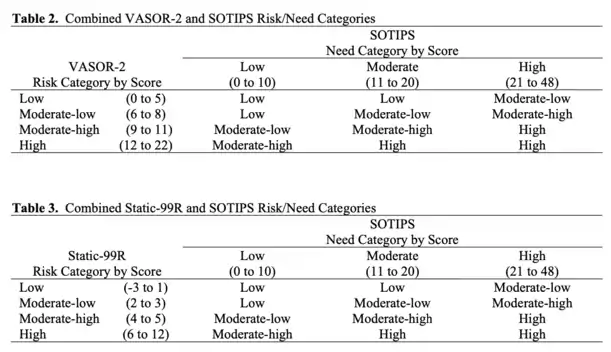
The SOTIPS is a dynamic risk assessment instrument used to assess risk, treatment and supervision needs, and progress in adult male sex offenders.[7] The SOTIPS is intended to be used in conjunction with a static risk measure, such as the Static-99R or the VASOR-2, and be conducted by a trained mental health professional. The SOTIPS can be used to assess risk, develop treatment and supervision needs, and measure progress.
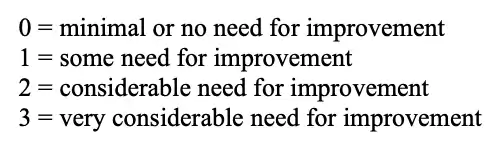
The instrument consists of 16 dynamic risk factors that are scored at intake and then again every six months. Each factor is scored on a 4-point scale ranging from minimal to no need for improvement (0) to very considerable need for improvement (3). The total score is computed by adding the number of risk factors scored 1, plus the number of risk factors scored 2 multiplied by 2, plus the number of risk factors scored 3 multiplied by 3. The total score is an estimation of a person’s overall level of dynamic risk and need for supervision and treatment.
The scoring criteria uses the following scale:
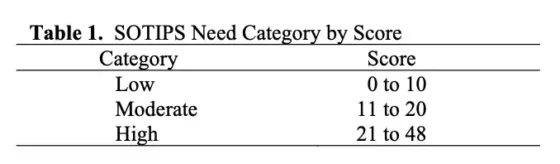
When the SOTIPS is used alone, the scores correspond to need categories as follows:
When the SOTIPS is used in combination with the VASOR-2 or Static-99R, the recommended risk/need categories are as follows:
[7] McGrath, R. J., Cumming, G. F., & Lasher, M. P. (2013). Sex Offender Treatment Intervention and Progress Scale (SOTIPS) Manual. Middlebury, VT: Author; McGrath, R. (n.d.). SOTIPS. McGrath Psychological Services, P. C. https://robertmcgrath.us/index.php/risk-instruments/sotips/

