
Autism Spectrum Disorder (ASD) is a life-long neurodevelopmental condition which affects how people communicate and and interact with the world around them. How autism presents in an individual is highly variable (a spectrum), but it is often marked by difficulties in social communication, a strong need for routine, focused interests, and sensory processing issues.
Defending Autism Cases
The lawyers at Johnson/Citronberg have a strong reputation for successfully defending individuals with autism spectrum disorder (ASD) who are facing criminal charges, especially internet sex offenses. We proudly represent individuals with autism in federal courts nationwide as well as in Virginia’s state courts.
Our lawyers are widely considered legal experts in defending individuals with autism, and our firm is routinely asked to comment on new legislation designed to protect criminal defendants with autism. For years, our criminal defense attorneys have worked closely with autism experts, including leading psychologists and psychiatrists, to get our clients’ criminal cases dismissed and reduced. Our approach includes a deep dive into mental health considerations and evaluations to ensure that judges and prosecutors understand autism and the difficulties faced by our clients and their families.
If you are looking for a law firm that understands autism and how to effectively represent individuals with autism, you have come to the right place. We will be happy to walk you through our step-by-step process for obtaining the best possible result for you or your family member.
CALL US TODAY 855-959-4003
Do I need a lawyer who specializes in autism?
Absolutely. To effectively represent a person with autism, a lawyer must understand how to work with psychological experts, navigate specific laws, and explain the medical diagnosis to judges and prosecutors.
Our criminal justice system is not designed to address autism, and individuals with autism often end up getting treated just as harshly (and sometimes even worse) than typical defendants. A lawyer must be able to explain how autism impacts online behavior, social boundaries, and decision-making. A lawyer must able be able to show that police investigations and interrogations often exploit an autistic person’s literal thinking. By using the latest scientific research and leading psychological experts, we are able to craft defenses specifically tailored to our clients’ individual autistic traits. At Johnson/Citronberg, we bridge the gap between criminal law and clinical psychology.
- Clinical Fluency in the Courtroom: We don’t just hire psychologists. We understand the science behind their opinions and reports. We are able to dismantle the prosecution’s arguments by explaining concepts like “Theory of Mind” deficits, missing social cues, and hyper-fixation.
- Educating the Legal Community: Both Cary and Jess are sought-after leaders in this highly niche field. They regularly teach Continuing Legal Education (CLE) seminars in which they instruct other defense lawyers on how to effectively represent autistic defendants.
- Strategic Medical Partnerships: We collaborate with the nation’s leading clinical psychologists and psychiatrists. From Yale to the University of Virginia, we have access to autism experts who have stellar backgrounds and are able to effectively testify in court.
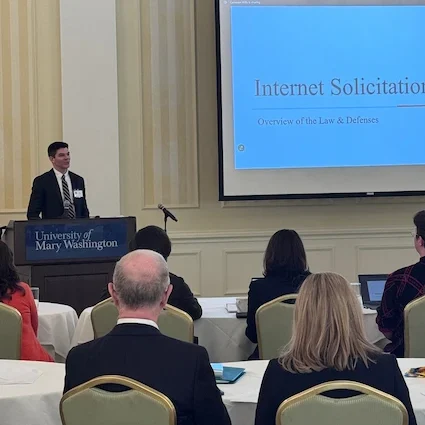
Jess teaches a CLE on autism and internet sex offenses.
An autism diagnosis is not an excuse, but it can lead to a dismissal or reduction. We are dedicated to ensuring that neurodivergent individuals are judged fairly, protected from predatory investigations, and kept out of the prison system. Our depth of experience and knowledge has made it possible for Johnson/Citronberg to consistently obtain dismissals, reductions, and the lowest sentences possible for our clients with autism.
Why are people with autism often charged with internet crimes?
Individuals with autism often experience social isolation and may spend large periods of time online. A strong curiosity, confusion about social norms and boundaries, and difficulty foreseeing consequences can sometimes lead to internet offenses, such as downloading illegal materials and soliciting minors.
In particular, people with autism may have a strong sexual curiosity about sex but have the emotional intelligence of a young child. They may also have difficulty putting themselves in someone else’s shoes along with a desire to collect things.
Because of these characteristics, someone with autism may find themselves charged with an internet sex offense such as possession of child pornography or solicitation of a minor. These offenses can carry severe consequences, including lengthy prison sentences and a lifetime of sex offender registration, which is why understanding how autism spectrum disorder can lead to criminal charges is so important when building an effective defense.
You can read more about how our firm defends against charges relating to child pornography and solicitation of a minor:
Related Practice Areas
Autism Criminal Defense Case Results
Virginia v. J.K.
Our Firm Obtains Dismissal of Child Pornography Charges for Client with Autism (Fairfax, Virginia)
Our client, a medical student, had his home raided by the FBI, and he was charged with possession of child pornography. We convinced the judge to dismiss the charges against him due to his autism diagnosis and its connection to the offense.
United States v. D.F.
Our Firm Obtains Not Guilty Verdict for Client with Autism (Northern District of Georgia)
Our client, a pilot and retired military officer, was diagnosed with autism. He was accused of knowingly transporting a large quantity of cocaine from southern Texas to Atlanta. If convicted, he likely would have died in prison. We were able to show a jury that our client had no knowledge of the drugs on board his aircraft due to his autism. The jury returned a not guilty verdict in less than an hour of deliberating.
Virginia v. R.C.
Our Firm Obtains Dismissal of Child Porn and Solicitation Charges for Client with Autism (Richmond, Virginia)
Our client, a working professional, was charged with distribution of child pornography after law enforcement raided his home. We helped our autistic client and convinced the court to defer all charges for dismissal due to his Autism Spectrum Disorder (ASD) diagnosis.
United States v. R.K.
Our Firm Obtains Lowest Sentence Possible in Child Porn Case for Client with Autism (Eastern District of Virginia)
Our client, a federal employee, was convicted of federal child pornography charges. Based on his autism diagnosis, we convinced a federal judge to give the lowest sentence possible.
Testimonials from Our Clients
Maybel G.
Jess is known for his meticulous and strategic work style. At his firm, there is a culture of excellence and client focused dedication that is unmatched. He is very thorough during the entire legal process and always finds a way to solve client problems.
View Live Review
Lyle Cartwright
Jess Johnson is the perfect attorney to overcome serious legal charges! He is very approachable & will use his expertise to give you the best criminal legal defense possible and I know this from personal experience. When you’re going through the scariest period in your life, you need the best lawyer on your side. I give him my highest recommendation!
View Live Review
Autism Quick Facts
- It is estimated that 4 million adults in the US have autism
- About 20% of people with autism will be stopped and questioned by police before the age of 21
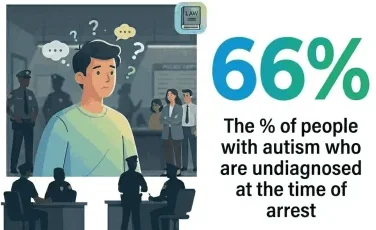
- Roughly 66% of people with autism are not diagnosed at the time of arrest.
- Nearly 18% of adults with autism have been arrested
- It is estimated that only 40% of people diagnosed with autism disclose their diagnosis at the time of arrest
- Nearly 44% of people with autism will be victimized
How does autism impact criminal cases?
Autism plays an important role in criminal cases because it directly impacts a defendant’s level of culpability. This simply means that the degree to which a defendant can be held responsible for a crime is reduced. We have discussed how autism can lead to the dismissal of criminal charges in some states, such as Virginia, when the relationship between the disorder and the conduct is clearly established.
When culpability is reduced, prosecutors may be less inclined to pursue charges, and judges may be more inclined to impose alternative or more lenient sentences. This can mean the difference between a lengthy prison sentence and no time in custody. An autism diagnosis can therefore be a powerful tool in criminal cases when used effectively.
Although lawmakers have increasingly recognized the importance of autism spectrum disorder in criminal cases, many prosecutors and judges still have a limited (and sometimes an incorrect) understanding of autism and how it can affect one’s behavior and decision-making abilities.
A good criminal defense lawyer will use an autism diagnosis at every stage of a criminal case to educate the prosecution and the court on why their client’s autism matters and why it should result in more lenient treatment. This is most effectively done by using clinical psychologists and psychiatrists who specialize in autism.
How do police interrogations affect suspects with autism?
People with autism are highly vulnerable during police interrogations. This is because people with autism struggle to read social cues, expect others to be honest, and take statements literally. As a result, they are at a heightened risk of being manipulated by police tactics.
People with autism share many traits that appear suspicious or incriminating to law enforcement, prosecutors, and judges. These traits include:
- Not making eye contact
- Odd body language
- Slow or inappropriate responses to questions
- Avoiding or evading police
- Not being able to articulate what happened or coming across as argumentative, disrespectful, or controlling
- Answering questions inconsistently
- Not understanding what police want from them
- Focusing on immaterial facts
Autism also increases the odds for a false confession. Techniques used by law enforcement when interrogating suspects can produce a false confession in people with autism. For example, during an interrogation, a police officer may ask if the suspect has ever thought about robbing a bank. While most people have had a passing thought about robbing a bank, they understand that these were not serious thoughts and answer in the negative. A person with autism, however, may take the question literally and respond with a “yes.”
In addition, police will often lie in an interrogation and say that they have evidence that the suspect committed the crime. People with autism generally have an expectation that others are being honest with them, and because of this, they may begin to doubt their own memory and agree with the police. These tactics have unfortunately led to autistic individuals being wrongfully convicted and spending years in prison. This is why it is critically important to have a lawyer that understands the importance of autism in the context of police investigations.
Autism Criminal Defense Legal Resources
- Autism Resource Center — Provides statewide autism-related support, education, and guidance for individuals with autism and their families.
- Virginia Crisis Services / 988 — Offers crisis support for individuals and families who need immediate mental health assistance in Virginia.
- REACH Crisis Services — Provides 24/7 crisis support for individuals with developmental disabilities, including many people with autism, in Northern Virginia.
- Autism Speaks – Judicial System Resources — Shares useful information about autism and court-related issues for families and professionals.
How our defense firm has helped clients with autism
Our firm has helped many clients with autism get their cases dismissed. When we’re not able to obtain a dismissal, we are often successful in getting a reduction to a lesser charge or a lenient sentence.
From our office in Alexandria, Virginia, the lawyers at Johnson/Citronberg represent clients in federal court everywhere and in Virginia’s state courts. If you have autism and have been charged with a crime, give us a call. The initial consultation is always free of charge.
Frequently Asked Questions
Meet Our Attorneys

Jess Johnson
Jess B. Johnson is a Partner & Founder at Johnson/Citronberg, PLLC with more than 15 years of experience in criminal defense and civil litigation. He represents clients in federal courts across the country and is licensed in Georgia, Virginia, and Washington, D.C. Jess has handled complex investigations, trials, and appeals for elected officials, business leaders, whistleblowers, and individuals. He has secured dismissals, acquittals, favorable sentences, and major whistleblower awards. A University of Georgia graduate, Jess was selected as a “Rising Star” by Super Lawyers Magazine every year since 2012.
View Profile
Cary Jacob Citronberg
Cary Jacob Citronberg is the Partner and Founder of Johnson/Citronberg, PLLC in Alexandria, Virginia, where he focuses on federal and state criminal defense matters. Licensed in Virginia since 2011, he brings more than 14 years of courtroom experience along with a strong record of advocacy. Cary received his J.D. from Georgetown University Law Center in 2010 after earning his B.A. from Northwestern University in 2006. His work has been repeatedly recognized by Super Lawyers, with selections as a Rising Star from 2016 through 2021 and to the Super Lawyers list from 2022 through 2025.
View Profile
