|
|
Last Modified on Apr 15, 2026
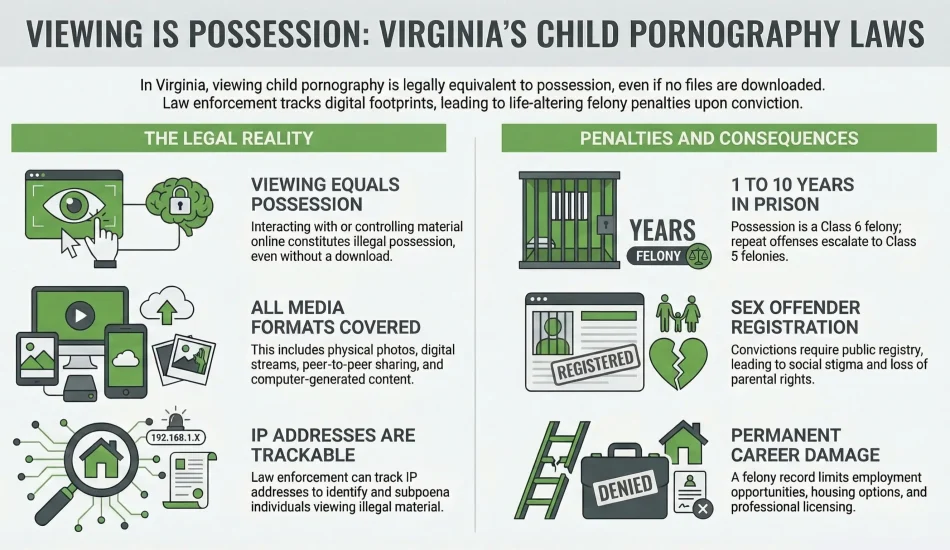
Viewing child pornography without downloading can still lead to charges in Virginia because the law treats viewing, receiving, downloading, or otherwise interacting with or being in control of sexually explicit material involving a minor as possession. The content explains that there is very little legal difference between viewing and possessing, and that even material viewed online or sent by a third party can still result in possession charges if the person is knowingly controlling the material. These cases can lead to felony charges, prison time, fines, sex offender registration, and lasting personal and professional consequences. The content also explains that law enforcement may investigate viewing activity through devices, browsing history, electronic records, IP addresses, warrants, and subpoenas. Understanding how Virginia treats viewing child pornography is important because charges may still arise even when no file was actually downloaded.
Child pornography charges often involve complex data analysis, which may lead you to wonder, “Does viewing child pornography without downloading still lead to charges in Virginia?” The answer is yes, viewing without downloading is still illegal. Learning more about how cases are investigated, along with the laws surrounding child pornography possession, can be crucial. An attorney from Johnson/Citronberg can explain the consequences of viewing child pornography.
Understanding Possession in a Child Pornography Case
Virginia child pornography laws strictly outlaw possessing child pornography, which includes viewing, receiving, downloading, or otherwise interacting with or being in control of sexually explicit material involving a minor. If you are charged with possession, hire a dedicated child pornography lawyer as soon as possible to begin defending your rights. In many instances, how often people are falsely accused of child pornography highlights the need for a rigorous defense against technical misunderstandings.
A case that involves physical child pornography material is also considered possession, even though it does not involve digital downloads. Physical photos, videotapes, or undeveloped film can all lead to possession charges. In Virginia, 1,077 crimes involving pornography or obscene material occurred in the home, while 872 occurred in cyberspace throughout 2024. In the digital age, understanding how peer-to-peer file sharing can lead to child pornography charges is vital, as these platforms can automate downloads without the user’s explicit intent.
In Virginia, the Northern Virginia and District of Columbia Internet Crimes Against Children (NOVA-DC ICAC) Task Force investigates cases involving both physical and digital child pornography material. This includes over 52 agencies at the local, state, and federal levels. The Federal Bureau of Investigation, the Virginia State Police, and many local departments, such as the Arlington Police Department, may all investigate possession.
Virginia’s Child Pornography Penalties
In general, possessing child pornography is a Class 6 felony, while repeated offenses become a Class 5 felony. A child pornography conviction can lead to:
- Prison. Most first child pornography possession offenses are punished by between one and five years in prison. Second offenses can result in between one and 10 years.
- Fines. Child pornography possession is punishable by up to $2,500in fines.
- Limited opportunity. With a permanent criminal record, you may face challenges in finding future opportunities. Your ability to find employment, secure housing, and obtain certain professional licenses can all be impacted by a child pornography offense.
- Damaged relationships. A child pornography possession offense leads to registry as a sex offender, which is visible to the public. Many offenders may face social stigma due to this. Additionally, a conviction may impact you in a child custody case, as your offense may be used to limit custody or visitation rights.
Many child pornography cases that occur in Virginia may be federal crimes, especially when they involve multiple states or countries. Federal charges are particularly common in cases involving digital child pornography, as online media easily crosses state lines. These crimes are tried in a federal court, rather than Virginia state courts, and carry federal penalties. A child pornography attorney at Johnson/Citronberg can explain who has jurisdiction in your case.
Search and Seizure Rights During a Child Pornography Investigation
Under the Fourth Amendment, you are legally protected against unreasonable searches. If law enforcement asks to search, avoid giving your consent unless they have a warrant. Even if you did not download child pornography, law enforcement may still find evidence of viewing or searching for child pornography on your device and electronic records.
Law enforcement can lawfully search if they present a warrant. This may involve a search of your home, and it could also involve a search or seizure of your personal electronics. A Virginia child pornography attorney can defend your Fourth Amendment rights, preventing police from attaining unnecessary evidence against you without a warrant.
Law enforcement may also use a subpoena to search for information. This gives law enforcement the ability to search for specific evidence. Most commonly, a subpoena is issued to collect digital records from your internet provider or tech company.
FAQs
What Is the Difference Between Viewing and Possessing?
Legally, there is very little difference between viewing and possessing, as they can both lead to charges of child pornography possession. Viewing child pornography on online services or platforms, along with viewing material that was sent to you by a third party, still counts as possession because you are knowingly controlling child pornography. This is true, even if you did not download the material.
What Is Illegal to Look at Online?
Searching for or looking at child sexual abuse material (CSAM) and other child pornography material online is illegal. This includes any photos, videos, computer-generated content, or digitally manipulated content that shows a minor being sexually abused, involved in a sexual act, or in a sexually suggestive way. Viewing child pornography can lead to possession charges, despite private browsers, not searching for the material, or the minor being above the age of consent.
Can Law Enforcement See My Browsing History?
Yes, law enforcement can see your browsing history, though it requires specific authorization. To view your browsing history, you must provide your consent, or the officers must obtain a warrant or subpoena. They may investigate directly from your device, though they can also gather evidence by obtaining reports from search engine companies or internet service providers. This can provide evidence of your search, download, and viewing history.
Can Law Enforcement Track Who Views Child Pornography?
Yes, law enforcement can track who views child pornography. They can see the IP addresses of those who open or view child pornography material. They can then subpoena the internet service provider to learn the personal information attached to this IP address. Then, law enforcement can investigate the individual further, which may include questioning them or conducting searches and seizures of their personal electronic devices.
Hire a Child Pornography Lawyer at Johnson/Citronberg Today
Johnson/Citronberg has been providing strategic, results-focused criminal defense for over 30 years. We are experienced in Virginia and federal courts, allowing us to defend you in even the most complex federal child pornography cases. Our deep knowledge of the investigative process and Virginia child pornography laws is essential for protecting your rights during an arrest and investigation. Our firm can also work to build a defense that pursues reduced or dismissed charges.
It can be challenging to fully understand and navigate child pornography possession charges. To know more about your charges, their potential penalties, and how to defend against them, contact Johnson/Citronberg today.