|
|
Last Modified on Oct 14, 2026
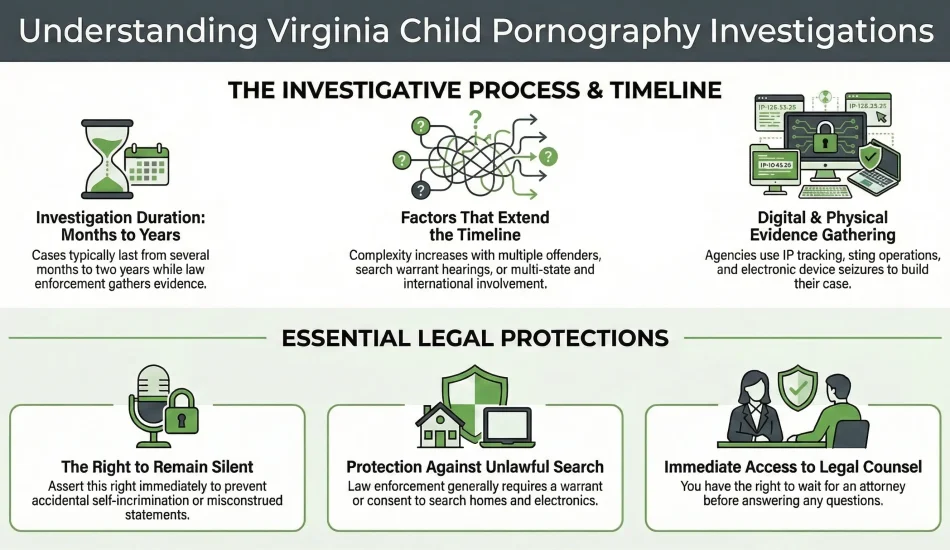
When agents search a home in a child pornography investigation and leave without arresting anyone, it usually means the case is waiting on a forensic examination of the seized devices. If charges come, they often follow months later, and federal law sets no deadline for filing them. That waiting period is the most important time to hire a defense lawyer, because it is the only stage when the outcome can sometimes be changed before any charge is filed.
Why agents search without making an arrest
A search warrant lets agents seize computers, phones, and storage devices. It does not mean prosecutors have decided to charge anyone. Investigators usually want to know what is actually on the devices, and who put it there, before a case moves forward. That matters when several people share a home, a computer, or a Wi-Fi network.
In Virginia, these investigations are often handled by the state’s Internet Crimes Against Children task forces, the Virginia State Police, and local police agencies. State police will often work in conjunction with the FBI or Homeland Security Investigations. Depending on the facts, a case may be charged in Virginia state court or referred for prosecution. You can visit our main page on federal child pornography cases to learn how we defend these cases in federal court. You can visit our main page on Virginia child pornography cases to learn how we defend these cases in Virginia state court.
How an IP address leads to a search warrant
Most of these investigations start with an IP address. When an online service reports suspected child sexual abuse material, or investigators detect it being shared on a peer-to-peer network, the report includes the IP address involved. Agents then subpoena the internet provider, such as Comcast or Verizon, for the name and address on the account, and use that to get a search warrant for the home.
An IP address identifies an internet account, not a person. Everyone in the household, guests, and anyone using an unsecured Wi-Fi network shares the same address. That is one reason agents often search first and decide whom to charge only after the forensic examination.
How long until charges are filed?
There is no set timeline. Forensic examinations are often backlogged, and in our experience charges commonly come several months after a search, sometimes a year or more. Some investigations end with no charges at all.
Waiting does not run out the clock. There is no statute of limitations for federal child pornography offenses (18 U.S.C. § 3299), and Virginia generally has no statute of limitations for felonies.
Signs that a case is moving toward charges include follow-up contact from agents, grand jury subpoenas to people you know, or a target letter. That is a letter from a federal prosecutor saying you are a target of a grand jury investigation, meaning someone the prosecutor regards as a likely defendant. Prosecutors are encouraged to send one before seeking an indictment in some cases, but in many child pornography cases, the first formal notice is an arrest.
What to do while you wait, and what to avoid
- Don’t talk to investigators without a lawyer. Agents often follow up with a call or a request for a “quick conversation.” Anything you say can be used against you, and a lawyer should handle all communication.
- Don’t delete, wipe, or destroy anything, including online accounts, cloud storage, or devices the agents didn’t take. Destroying evidence to obstruct a federal investigation is a separate felony carrying potentially significant prison time (18 U.S.C. § 1519).
- Don’t discuss the investigation by text, email, or social media, even with family. Those messages can become evidence.
- Write down what you remember about the search and share it with your lawyer.
- Hire a defense lawyer now, not after an arrest.
What a defense lawyer can do before charges
The pre-charge stage is when a defense lawyer has the most room to work. A lawyer can:
- Find out where the case stands by contacting the lead agent or the prosecutor.
- Bring in an independent computer forensics expert early. In one of our cases, involving a technology executive, our expert examined the seized devices before any arrest and showed the downloads were unintentional. The government agreed not to arrest our client.
- Arrange a voluntary surrender if charges are coming, so that you aren’t arrested at home or at work.
- Prepare for the detention hearing in advance, which can decide whether you go home on bond after a first court appearance.
- Negotiate before an indictment, where that serves you. In some federal districts, prosecutors offer more favorable terms before a case is indicted.
Getting your devices back
The government usually keeps seized devices until the investigation and any prosecution are over. A device that contains illegal material will not be returned. For other property, federal rules let a person ask the court for its return (Fed. R. Crim. P. 41(g)), and a lawyer can sometimes negotiate copies of lawful files, such as family photos or work documents.
Other consequences while you wait
An investigation can affect more than the criminal case. If children live in the home, child protective services may open a separate investigation, which can affect custody and family court matters. Many people also worry about their jobs and reputations; we cover that in protecting your privacy during an investigation.
Frequently asked questions
If I wasn’t arrested, does that mean I won’t be charged?
No. Most charges in these cases come after the forensic examination, often months after the search. Some investigations do end without charges, especially when the forensic evidence doesn’t support them.
Will I receive a target letter before I’m charged?
Not necessarily. Federal prosecutors sometimes notify targets before seeking an indictment, but in many child pornography cases the first notice is an arrest or a criminal complaint.
Should I call the agent to explain?
Explanations given to agents become evidence. If there is an innocent explanation, a lawyer and a forensic expert can present it in a way that protects you.
Can I get my phone or computer back?
Usually not until the case is over, and never if it contains illegal material. A lawyer can sometimes arrange copies of lawful files sooner.
Talk to a lawyer before charges are filed
Johnson/Citronberg represents people under investigation for federal and Virginia child pornography offenses, from offices in Alexandria, Virginia and Atlanta, Georgia. If your home has been searched, contact us for a confidential consultation. What happens before charges are filed can change the outcome of the case.