|
|
Last Modified on Apr 21, 2026
Do child pornography cases involving anonymous browsers carry harsher penalties in Virginia? Child pornography cases are never dealt with lightly in Virginia, but when the use of an anonymous browser is involved, you may be wondering if charges change. Using private servers is often viewed negatively by the prosecution, judges, or jury, which may lead to more severe sentencing.
If you are involved in a child pornography case involving the use of an anonymous browser, consider hiring a child pornography attorney.
Johnson/Citronberg: Fierce Criminal Defense Attorneys
At Johnson/Citronberg, our team recognizes the immense difficulties associated with facing charges and accusations regarding child sexual abuse materials (CSAM). If you are being charged with or accused of offenses relating to CSAM, it is imperative that you secure trusted legal counsel that can advocate for you. Our attorneys have represented clients in complex federal and state cases, and can craft a tailored defense for you today.
What Is an Anonymous Browser?
Anonymous browsers and “private browsing” features, like Incognito mode, allow users to protect their privacy online. These services may block users’ IP addresses with a VPN and automatically clear search history, as well as cache/cookies. These tools are often used by people to avoid targeted ads and their data being stolen or sold. In fact, 41% of adults reported using a VPN for personal or business use.
However, when these services are used for nefarious reasons to conceal illegal digital materials, it can constitute illegal activity and potentially worsen your charges.
How the Prosecution Views Anonymous Browser Usage
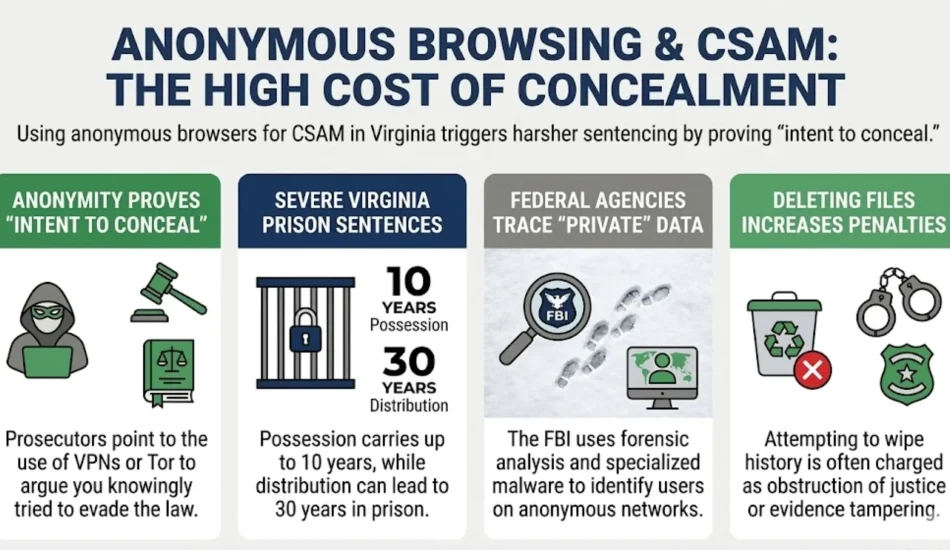
While using an anonymous browser or other tool for internet anonymity is not illegal, it can provoke the prosecution to make certain arguments when involved in a child pornography case. Anonymous browsers mask search history, downloads, and other activity. When this involves illegal materials, it appears to the court that there was an intentional attempt to conceal criminal activity.
The attempt to hide the criminal activity can incur harsher sentencing in child pornography possession and distribution cases, not the actual use of an anonymous browser. From 2018 to 2023, it was found that out of 176,683 private domains on anonymous servers, about one-fifth shared child sexual abuse material (CSAM).
Anonymous Browser Involvement in Federal Cases
The use of anonymous browsers implies that you are knowingly accessing illegal materials while attempting to remain undetected. Federal agencies such as the Federal Bureau of Investigation (FBI) perform investigations into anonymous networks like The Onion Network (Tor) and utilize forensic analysis to recover data that might otherwise remain hidden. Around 11% of all searches on Tor domains are for CSAM.
The federal government is committed to eliminating CSAM on the internet, and it is not forgiving in these cases. Law enforcement may even use their own malware to infect predators’ computers, leading them to the source of the illegal materials and revealing their true identities. When these operations are interstate or even international, they are handled by the federal government.
A skilled criminal defense attorney from our firm is familiar with the legislation relevant to your case and may be able to argue that the use of the anonymous browser was a legitimate effort to protect your personal privacy.
Penalties for CSAM Possession and Distribution in Virginia
The penalties for possession and distribution of CSAM in Virginia are harsh and strictly imposed. Skilled legal counsel may be able to aid you in mitigating your consequences or combating your charges. Common penalties for charges of this nature include:
- First Count of Possession: A class 6 felony that comes with up to five years in prison, and a maximum fine of $2,500.
- Second Count of Possession: A class 5 felony that comes with up to ten years in prison, and a maximum fine of $2,500.
- Distribution/Production: A class 5 felony that comes with five to 30 years in prison and immense fines.
- Failure to Register as a Sex Offender: A class 1 misdemeanor that comes with up to one year of additional jail time.
When Should I Hire a Child Pornography Lawyer in Virginia?
If you have been accused or charged with a child pornography related offense in Virginia, contact a local, experienced criminal defense attorney as soon as possible. These charges carry severe consequences and often come with negative stereotypes that can impact your future permanently. The team at Johnson/Citronberg is committed to defending the rights of Virginia residents, no matter how serious your charges may be.
FAQs
Are Distribution Charges Treated More Seriously Than Possession for CSAM?
Yes, charges of distributing CSAM carry much harsher penalties than a charge of possession. Sharing CSAM in any capacity counts as distribution, meaning there does not need to be any financial exchange for it to count as distribution. In addition to sentencing, those found guilty of distribution and possession of CSAM may be required to register as a sex offender. Being a registered sex offender can make it difficult to find places to live and work.
Can Each File Found Lead to a Separate Charge in Virginia?
In Virginia, each file of CSAM found may be eligible for its own charge depending on the content depicted. This is known as “stacking” charges and can be detrimental to the charged or accused offender, turning what may have been a single felony into dozens or even hundreds. To avoid these circumstances, you should hire a criminal defense lawyer who is well-versed in CSAM laws.
Does Deleting Illegal Files Prevent Criminal Charges in Virginia?
Deleting illegal files from your computer will not always prevent criminal charges. In fact, this can often make criminal charges more severe. Attempting to delete files to hide the criminal activity is often seen as a clear intent to conceal a crime, making it an obstruction of justice or evidence tampering. Forensic analysts may also be able to recover “deleted” materials.
How Do Investigators Identify Suspects Using Anonymous Networks?
There are several ways investigators can identify people, even if they are using anonymous networks or browser services. Even online, there is undercover law enforcement. They may visit forums and websites that are not on the surface web to find predators in their own communities. Commonly, these predators are identified by their own mistakes, such as sharing personal information.
Contact Johnson/Citronberg Today
Don’t hesitate to get the legal representation you deserve. Contact the team at Johnson/Citronberg today to learn more about your legal options.